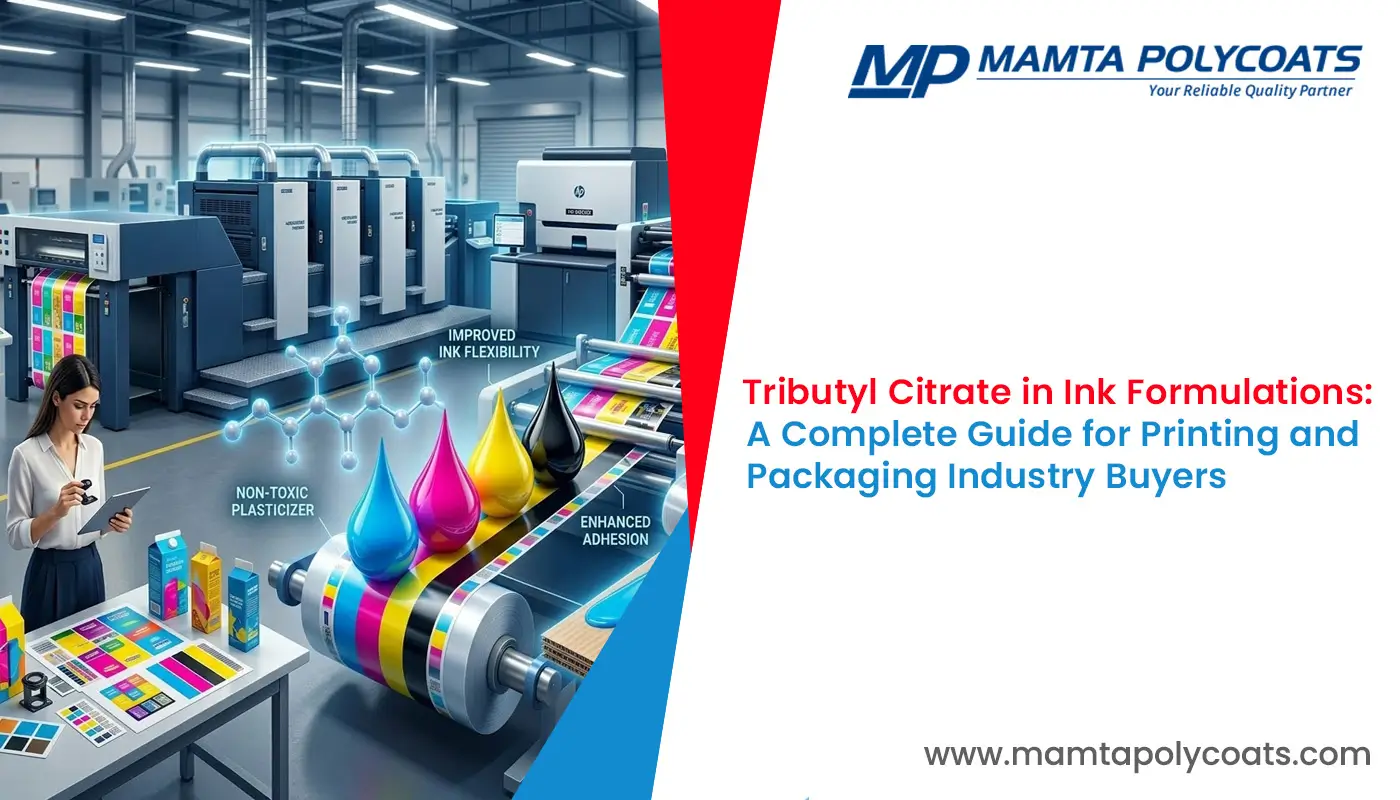
The global printing ink market has undergone a significant reformulation cycle over the past few decades. Stricter VOC regulations and demand for food-safe and migration-compliant packaging inks have urged brands to demonstrate sustainable and safer printing inks. Tributyl citrate (TBC) is a naturally derived, biodegradable and phthalate-free ester produced from citric acid and 1-butanol. The use of TBC in printing ink systems is rapidly expanding as industries are moving away from conventional petrochemical-derived solvents and plasticizers.
Tributyl citrate (CAS No. 77-94-1) is an ester of citric acid and 1-butanol, produced through direct esterification. At Mamta Polycoats, as a leading tributyl citrate manufacturer in India, our TBC is manufactured from naturally sourced citric acid using a carefully controlled esterification process. With a low colour value (APHA 50 max), TBC is crucial for applications where colour interference cannot be tolerated, including transparent or light-coloured ink systems. Tributyl citrate is basically transparent, colourless, with a faint, slightly fruity odour.
It is practically insoluble in water but soluble in a wide range of organic solvents, including acetone, methanol, ethanol, mineral oil, castor oil and acetic acid. The solubility profile of tributyl citrate makes it highly versatile in both solvent-borne and oil-based ink systems.
| Property | Value |
|---|---|
| Assay (GC) | 99.0% min |
| Colour (APHA) | 50 max |
| Specific Gravity (25°C) | 1.037 - 1.047 |
| Refractive Index (20°C) | 1.443 - 1.445 |
| Molecular Weight | 360.45 |
| Flash Point | 184°C |
| Pour Point | -62°C |
| Viscosity (25°C) | 32.9 mPa·s |
| Water Content (w/w) | 0.20% max |
The combination of a high flash point (184 °C) and a very low pour point (-62 °C) makes it operationally safe and processable across a wide range of temperatures for both ink manufacturing environments and downstream print operations.
Also Read: Triethyl Citrate Uses: Triethyl Citrate in Perfume
In fluid ink systems, particularly gravure inks and flexographic inks, where viscosity ranges from 15 to 200 mPa·s, TBC functions as a cosolvent and viscosity modifier. Its moderate viscosity and excellent compatibility with common ink resins allow tributyl citrate to be blended into solvent packages. It simultaneously also improves the dispersion quality of pigments and other solid additives.
TBC in the dried ink film as a permanent component, it acts as a resin plasticiser. It modifies the mechanical behaviour of the film in ways that are critical for flexible packaging applications.
The printing and packaging ink industry’s transition away from phthalate-based plasticisers and poorly documented petrochemical solvents. Tributyl Citrate (TBC) delivers the technical performance that ink formulators require, effective pigment dispersion, viscosity management, film flexibility and excellent compatibility with the resin systems. Ready to evaluate TBC for your ink formulation or packaging supply chain? Mamta Polycoats is a top tributyl citrate supplier in India for modern ink systems. To discuss your requirements, call us today.
Also Read: Tributyl Citrate is Replacing Phthalates in Resin Formulations
 Argentina









Address - 244/P, Padra-Jambusar Road, Dhobikuva Village, Padra, Vadodara, Gujarat, India 391 440.
 |
+91 98240 72230, +91 2662 267 230, +91 98258 72230 |
 |
info@mamtapolycoats.com |
 |
244/P, Padra-Jambusar Road, |